It Sure Looks Like Trump is About to Attack Cuba
Trump's Delcy Doctrine is being applied to Havana

Each week, there is at least one story that, in olden times, would have driven weeks of coverage and congressional investigations, but that under Trump just slips by with a shrug.
This week’s candidate: on Tuesday, the Times reported that the initial U.S.-Israeli plan for Iran was to decapitate the regime and install former Iranian president Mahmoud Ahmadinejad as the country’s next leader.
Interesting choice. If you remember Ahmadinejad when he was in power from 2005 to 2013, you probably recall that he was a hardliner best known for his vile and cartoonish rhetoric about Americans, Jews, and gay people. He wanted to “wipe Israel off the map,” denied the holocaust, repressed internal dissent, and championed Iran’s nuclear program. Ahmadinejad’s radicalism was all anyone needed to point to when making the case for containing Iran.
In the West, he became a caricature of Iranian religious zealotry and broke into American pop culture, including on SNL.
But since then, he’s undergone a strange transformation. He fell out of favor with the clerical regime, became a mild critic, was repeatedly barred from running for president again, and ended up on house arrest. The Times hints that at some point along this journey, Ahmadinejad may have become an Israeli asset.
The US-Israeli plan was to kill Ahmadinejad’s security minders with an airstrike, springing him from house arrest, and then somehow install him as the country’s new leader.
The Times piece is studded with surreal details, but, given the latest moves around Cuba, this paragraph, about why Trump liked the plan, stands out as particularly relevant:
Mr. Trump was enjoying the success of the raid by U.S. forces to capture Venezuela’s leader, Nicolas Maduro, and the willingness of his interim replacement to work with the White House — a model that Mr. Trump appeared to think could be replicated elsewhere.
In Ahmadinejad, Trump apparently thought he had found an Iranian Delcy Rodríguez.
It did not quite work out. The plan went sideways on the first day of the war when Ahmadinejad himself was wounded in the Israeli airstrike on the Iranian security forces guarding him. “He survived the strike,” according to the Times’ sources, “but after the near miss he became disillusioned with the regime change plan.” He has not been seen publicly since.
Despite this fiasco, the pieces now appear to be falling into place for Trump to attempt another Maduro repeat, this time in Cuba.
First, military assets are moving into place. The USS Nimitz aircraft carrier strike group entered the southern Caribbean yesterday, “as part of the Trump administration’s campaign to pressure the Cuban government.” The amphibious assault ship Tripoli, which was part of the Maduro raid buildup, remains in the region (though many other pieces of military hardware from that operation departed for the attack on Iran). CNN recently revealed that the U.S. military has been conducting dozens of intelligence-gathering flights near Cuba’s big cities since February. And CBS adds that the U.S. intelligence community is “exploring how Cuba might respond to an American military action” as the Pentagon develops military options for Trump.
Second, a flimsy military pretext has been floated in the press. On Sunday, Axios, citing an unnamed U.S. official, reported that Cuba has acquired more than 300 military drones and has allegedly discussed using them on Guantanamo Bay, naval ships, and Key West. (As Sen. Ruben Gallego pointed out,
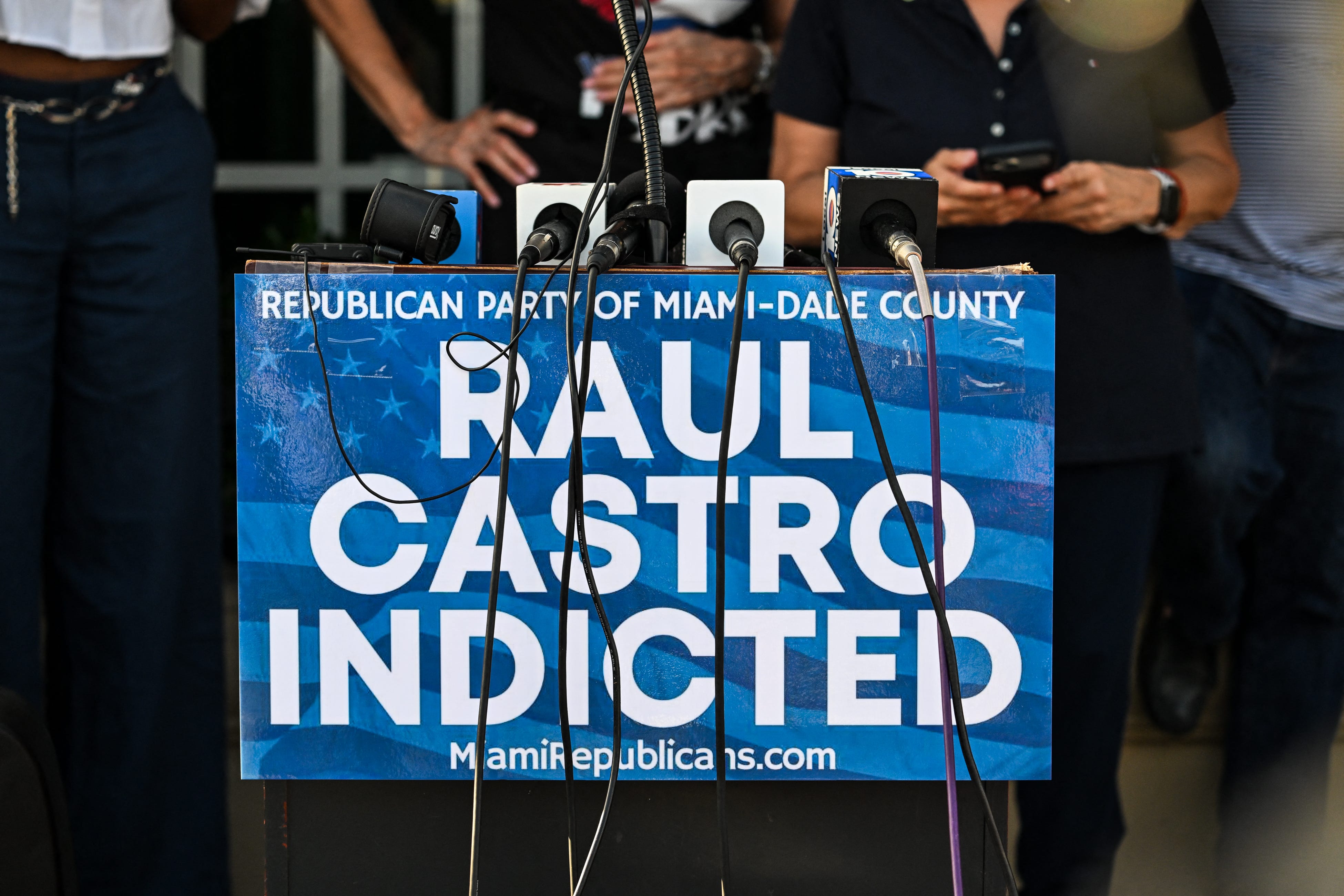
Third, a flimsy legal pretext was unveiled yesterday, Cuban Independence Day, when an indictment against the 94-year-old former president Raúl Castro for conspiracy to kill U.S. nationals, murder, and destruction of aircraft was publicly unsealed in the U.S. District Court for the Southern District of Florida. Acting Attorney General Todd Blanche took time away from creating the new slush fund for J6ers to personally announce the indictment in Miami. Blanche also made what sounded like a threat: “There is a warrant issued for his arrest. We expect that he will show up here by his own will or by another way.” (Recall that Maduro was indicted in 2020 and captured by U.S. forces in January 2026.) Trump called the new Castro indictment “a very important moment” for Cuba.
All of this follows months of diplomatic threats and economic pressure. A U.S. oil blockade has been in place since January, and Cuba has run out of diesel and fuel oil, triggering rolling blackouts. The US announced new sanctions targeting Cuban military leaders on Monday.
Secretary of State Marco Rubio has held direct talks with Raúl Guillermo Rodríguez Castro, a grandson of Raúl Castro known as “Raulito.” The U.S. has been pushing him and other members of the Castro family to remove Cuban President Miguel Díaz-Canel, which, per the NYT, “would allow the Trump administration to argue it had successfully engineered political change in Cuba.” Meanwhile, CIA Director John Ratcliffe recently traveled to Havana and met with Raulito and intelligence officials. He told them that the Trump administration was offering “a genuine opportunity for collaboration,” but, as CBS ominously noted, the offer “would not remain open indefinitely.”
Yesterday, the same day as the Castro indictment and the Nimitz’s movement into the area, Rubio suggested that time was running out. He delivered a Spanish-language video address to the Cuban people, declaring, “President Trump is offering a new path between the U.S. and a new Cuba.”
There is, of course, no sign that Trump intends to seek congressional approval for the use of force in Cuba, as George W. Bush did before the wars in Afghanistan and Iraq, or to bring the issue to the United Nations, as Barack Obama did before the bombing of Libya.
And why would he? After the attacks on Venezuela and Iran, Trump knows that there is no institution or countervailing force that will rein in his military adventurism, including popular opinion.